
Google Is Quietly Stealing
Your Website Clicks
If you’ve checked your rankings lately and everything looks fine, but the phone isn’t ringing like it used to, you’re not imagining it. Google is answering your customers’ questions directly on the results page now, before they ever reach your website. Your ranking didn’t drop. Your click just got stolen.
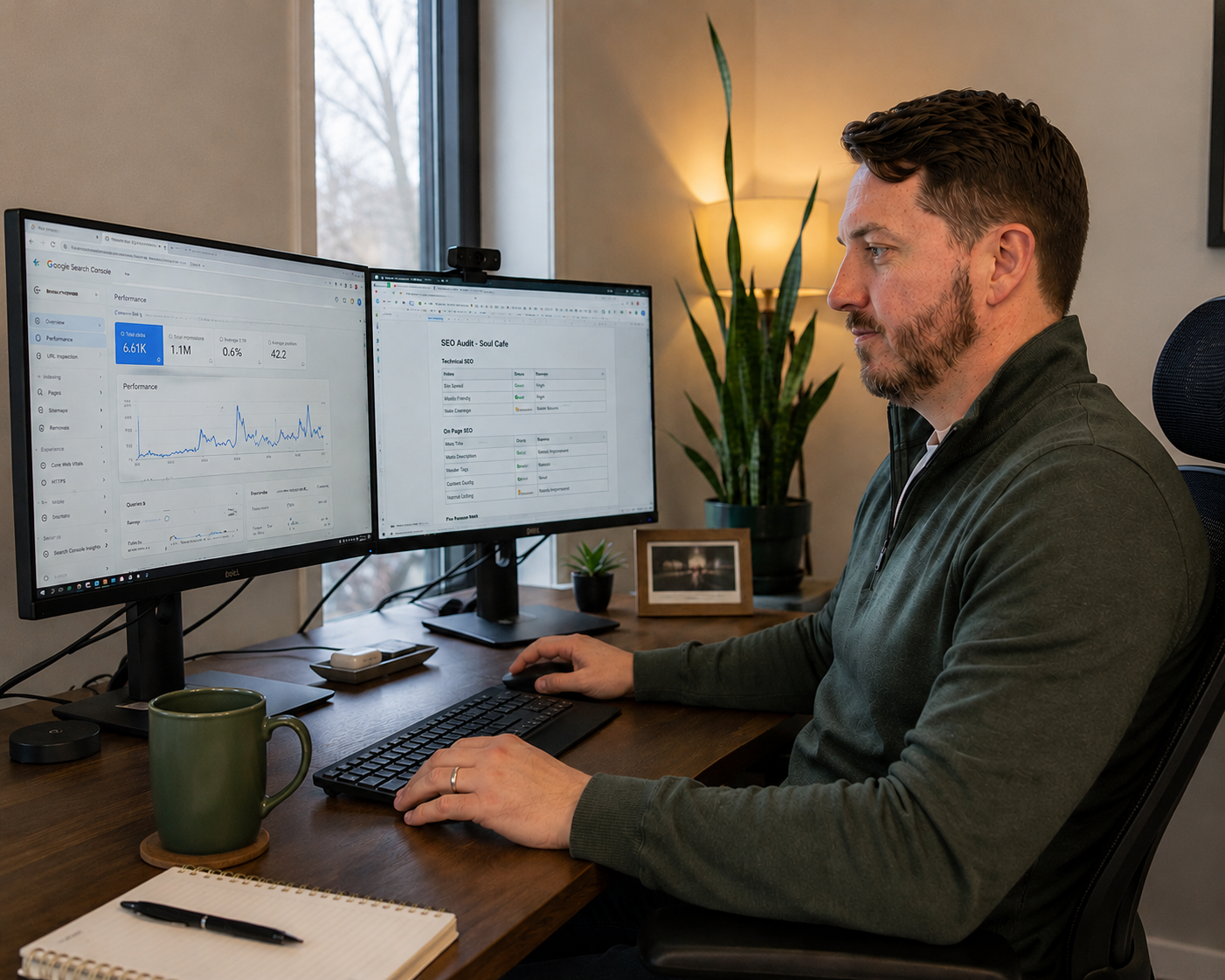
Reviewing search performance data for a Metro Detroit client account
How Google Is Taking Your Clicks Without You Noticing
Google now shows an AI-generated answer above the regular results for almost every informational search. Someone types “how much does a kitchen remodel cost” or “what does an emergency plumber charge,” and the answer appears right there on the results page. No click required. The searcher got what they needed before they ever reached a website, and your business doesn’t even know it lost the visit.
This is the part that makes it feel invisible. I’ve been watching this play out across client accounts for the last two quarters, and the pattern holds up. Rankings for informational, “what is” and “how to” style keywords are staying steady in Search Console, but the clicks tied to those same keywords are dropping, in some cases by 30 to 40 percent year over year. Nothing in your dashboard tells you a theft occurred. Your position looks exactly the same. The click just quietly stopped happening, and if you’re not checking click through rate specifically, you’d never know.
Not Every Click Is Being Stolen
Here’s the important part. Google isn’t stealing every click equally, and once you see which searches are vulnerable, you can stop losing sleep over the ones that aren’t.
Decision stage searches
“Best HVAC company in Troy,” “[competitor] vs [competitor] pricing,” “is it worth hiring a plumber in Sterling Heights.” People this close to hiring someone don’t want a summary. They want the actual page, the actual reviews, the actual pricing.
AI-generated answers are weakest exactly where trust matters most. A generic AI overview can tell someone what a sump pump does. It can’t tell them which Warren-based plumber shows up on time and stands behind the work. That gap is where Google can’t steal the click even if it wanted to, because the answer doesn’t exist anywhere except your business.
Stop asking “will this rank.” Start asking “do I still get anything if Google answers it for free.”
That’s the filter I’m now running every piece of content through before recommending it to a client. If a blog post is answering a question Google’s AI can already answer on its own, in its own words, using publicly available information, that post isn’t going to earn a click no matter how well it ranks. It might as well not exist.
But if a page includes something the AI genuinely cannot generate, your own before-and-after project photos, your own pricing structure, a named example from an actual Oakland County job, a real review that names a real technician, that page becomes something worth clicking through to. Information nobody else has is the whole game now.
Publishing forty generic blog posts a month to catch long tail searches was never really an SEO strategy. It was an arbitrage on cheap information, and that arbitrage has closed. What replaces it is fewer pages that actually carry weight, built from things a competitor can’t simply copy or an AI can’t simply summarize.
Max Krentz, Max Authority SEOWhat This Means for Your Metro Detroit Business
Redirect content effort toward decision stage pages
Instead of another generic “what is local SEO” style post, build pages that answer the comparisons and pricing questions your actual prospects are asking right before they call. Think “[your service] cost in [city],” “[your service] vs [alternative],” or “is [your service] worth it in Metro Detroit.” Those searches still convert into clicks because the searcher is trying to make a decision, not collect a summary.
Treat your Google Business Profile as the trust layer AI can’t fake
Detailed reviews that name specific services, staff, and neighborhoods give AI tools and human searchers alike something concrete to point to. A five star rating with no text is easy for an AI overview to ignore. A review describing a real job in Berkley or Royal Oak is not.
Publish what only you have
Your own job photos, your own pricing breakdowns, your own client results, your own answers written in your own voice about your own service area. Original material is the only kind of content that still earns a click when the free answer is sitting right above it.
Don’t abandon organic entirely
Branded searches for your business name, comparison searches, and anything tied to a real community reputation are still performing well. This isn’t a call to give up on SEO. It’s a call to stop spending the bulk of your effort on the half of it that’s fading and start putting that effort into the half that’s actually growing.

Walking a client through a decision stage content plan for their service area
Pull up your own Search Console data and look at click through rate on your informational keywords over the last two quarters. If rankings held steady but clicks dropped, that’s your confirmation. Don’t guess at this. The data has been sitting there for months.
Frequently Asked Questions
No. It’s changing shape. Informational content that Google’s AI can summarize on its own is losing clicks even when rankings hold steady. Decision stage content, comparisons, pricing pages, and anything built on real local trust signals is holding up well and in many cases becoming more valuable. The businesses treating this as the end of SEO are missing where the opportunity actually moved.
Not entirely, but I’d stop writing generic explainer posts that any AI tool can already answer. Shift that same effort toward pages that answer real decision stage questions specific to your service and your cities, things like pricing, comparisons, and honest answers to “is this worth it.”
Check Google Search Console for your informational keywords and compare click through rate over the last two quarters, not just the last few weeks. If your position held steady but your clicks dropped, that’s a clear signal the click is being absorbed by an AI-generated answer above your listing.
Content built on something an AI can’t generate on its own: your actual pricing, your actual before and after work, named reviews from real customers, and direct comparisons against alternatives. Branded searches for your business name and community-driven searches also continue to perform well.
- Decision stage pages: pricing, comparisons, “is it worth it” content specific to your service and city
- Reviews that name specific services, staff, and neighborhoods
- Original job photos, pricing breakdowns, and real client results
- Fewer generic explainer posts, more pages built on what only you know
- A Search Console review of click through rate trends before writing your next post
Not Sure Which Half Your Content Is On?
I offer a free SEO audit for Metro Detroit businesses. I’ll look at your current content, your Google Business Profile, and your search performance data, and tell you exactly where you’re losing clicks to AI Overviews and what to build instead.
Get Your Free SEO Audit